

When your Ice Maker Doesn’t Make Ice, it’s rarely “mystical.” Most of the time it’s one of a handful of fixable issues: no water, not cold enough, a blocked fill tube, a stuck sensor, or a simple setting that got switched off. This guide walks you through the checks that solve the majority of cases—without guessing and without needing special tools.
Confirm the Basics
Before you take anything apart, do these quick checks. Many “dead” ice makers come back to life right here.
- Is the ice maker turned ON? Some models have a switch, a button in the control panel, or a metal/bail arm that must be down.
- Is the door fully closing? A slightly open freezer door can warm the compartment and stop ice production.
- Is the ice bin seated correctly? If the bin is misaligned, some units pause production.
- Did you recently move the fridge or replace a filter? Air in the line can delay ice for several hours.
If your Ice Maker Doesn’t Make Ice even after these basics, keep going.
Book Online and Save $25




The Most Common Cause: Temperature
Ice makers typically need the freezer to be cold enough to complete the harvest cycle.
What to check
- Freezer should usually be around 0°F / -18°C.
- If it’s closer to 10°F / -12°C or warmer, ice production may slow or stop.
Quick fixes
- Reduce freezer setpoint by 1–2 degrees and wait 12–24 hours.
- Make sure vents aren’t blocked by food packages.
- Check that the condenser coils (often at the back/bottom) aren’t heavily clogged with dust.
When the freezer is too warm, the Ice Maker Doesn’t Make Ice because the mold never fully freezes—or the mechanism won’t eject cubes properly.
Water Supply: The Other Big One
No water in means no ice out. Sounds obvious, but water issues can be subtle.
Check these in order
- Water shutoff valve (behind the fridge or under the sink): fully open?
- Kinked or crushed water line: especially after pushing the fridge back.
- Frozen fill tube: a small tube that delivers water into the ice mold can freeze shut.
- Water filter: clogged filters can reduce flow so much that the ice maker can’t fill.
If your Ice Maker Doesn’t Make Ice, a partially clogged filter is a classic: the dispenser may still work “okay,” but the ice maker needs a stronger, consistent fill.
Symptoms → Likely Cause → What to Do
| What you notice | Likely cause | Best next step |
|---|---|---|
| No ice at all, no sound, no movement | Ice maker is off / paused | Turn ice maker on, lower bail arm, check control panel setting |
| Ice is tiny, hollow, or misshapen | Low water pressure / clogged filter | Replace filter, check shutoff valve, inspect water line for kinks |
| Ice maker clicks but no ice forms | Frozen fill tube | Thaw fill tube (hair dryer on low from a distance), check freezer temp |
| Ice production is very slow | Freezer too warm / airflow blocked | Confirm -18°C/0°F, clear vents, avoid overpacking |
| Ice bin overflows or cubes clump | Door seal leak / humidity / sensor issue | Check gasket, ensure door closes, clear ice clumps, reset unit |
| Water leaking near ice maker | Loose connection / cracked line / overfill | Inspect connections, look for split tubing, consider inlet valve issue |
Keep this table handy; it maps most “Ice Maker Doesn’t Make Ice” cases to a sensible next move.
Fixes That Solve the Majority of Problems
1) Reset the ice maker (safe and quick)
Many models support a reset that restarts the cycle.
- Look for a reset/test button on the ice maker module or behind the front cover.
- Some units reset by turning the ice maker off for 1 minute and back on.
- After reset, wait up to 2 hours for the first batch (sometimes longer if the line needs to refill).
If an Ice Maker Doesn’t Make Ice after a reset, the issue is usually water, temperature, or a blocked mechanism.
Discover Solutions for Other Common Refrigerator Issues


2) Inspect the ice mold and ejector area
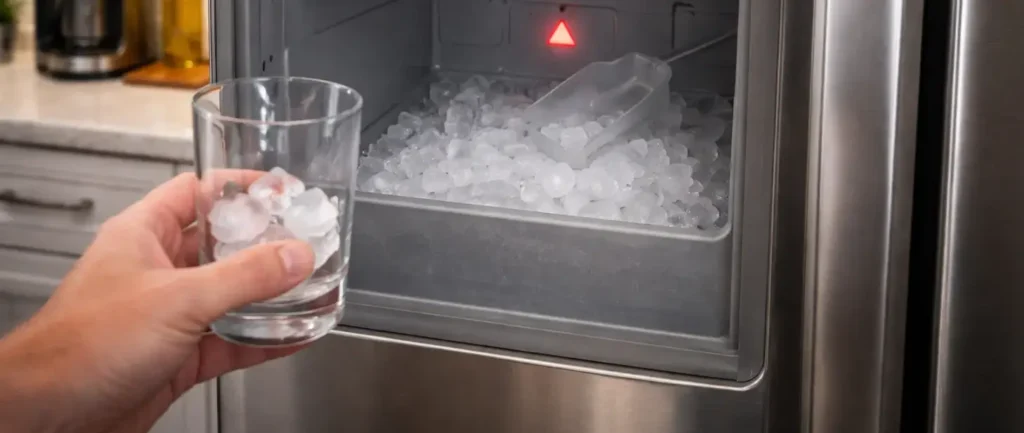
Open the freezer and look at the ice maker itself.
- Is there ice stuck in the mold? Remove stuck cubes (gently) and check if the ejector arms can move.
- Is there a solid block of ice? That can point to overfilling or slow harvesting (often temperature-related).
A jam can make it seem like the Ice Maker Doesn’t Make Ice, when it’s actually making ice but can’t eject it.
3) Check the fill tube for freezing
A frozen fill tube prevents water from reaching the mold.
How to tell:
You’ll see an empty mold and no fresh water entering during a cycle.
What to do (basic approach):
- Unplug the fridge (or switch off power) for safety.
- Thaw the tube carefully using warm air (low heat, keep distance).
- Then address why it froze: freezer too cold in that corner, poor airflow, or a valve that’s “dribbling” water and freezing.
4) Replace the water filter (if it’s due or unknown)
If you can’t remember the last replacement, treat it as a real suspect.
- Replace with the correct type.
- After replacement, flush water per the filter instructions (often a few liters/gallons).
- Give the ice maker time to refill and cycle.
A worn filter is a quiet reason an Ice Maker Doesn’t Make Ice consistently.
When It’s Likely a Part Issue (and what part)
If you’ve confirmed:
- freezer temp is correct,
- water supply is open and flowing,
- filter is good,
- fill tube isn’t frozen,
- and settings are correct,
…then the next suspects are parts. Here are the most common:
- Water inlet valve: can fail or clog internally, leading to weak/no fill.
- Ice maker assembly/module: motor or control can die.
- Optical sensor / shutoff switch: may think the bin is full when it’s not.
- Door switch: if the freezer thinks the door is open, some models pause ice making.
At this stage, it helps to look up your model’s diagnostic mode—but even without that, you can often pinpoint the issue based on whether water ever enters the mold and whether the mechanism cycles.
Quick “Do This, Not That” List
-
Do confirm freezer temperature with a thermometer if possible.
-
Do check for a kinked water line after moving the fridge.
-
Do replace an overdue filter before blaming expensive parts.
-
Don’t chip ice with sharp tools (you can crack the mold).
-
Don’t set the freezer extremely cold to “force” ice—this can freeze the fill tube.