


Seeing water leakage under the fridge is stressful, but it’s usually caused by a few predictable issues—most of them fixable without a service call. Below is a practical, step-by-step guide to find the source, stop the leak, and prevent it from coming back.
Identify What Kind of Water It Is
Before you start disassembling anything, do a quick check:
- Clear, odorless water: often condensation, a clogged defrost drain, or an ice maker line.
- Sticky water: could be spilled drinks/food inside the fridge that ran down.
- Water only after ice use: likely a water supply connection or filter issue.
- Water only after defrost cycles: points to a defrost drain or drain pan problem.
If water leakage under the fridge is constant and spreading quickly, unplug the fridge for safety and protect the floor with towels.
Book Online and Save $25




Quick Diagnosis
| Symptom you notice | Most likely cause | Where to check | DIY difficulty |
|---|---|---|---|
| Puddle at the front, inside bottom shelf feels wet | Clogged defrost drain | Back wall of freezer/fridge, drain hole | Medium |
| Water near the back, especially after using ice/water | Loose or cracked supply line | Behind fridge, water inlet valve, tubing | Medium |
| Dripping during humid days, no ice maker involved | Condensation from door seal leak | Door gasket, door alignment | Easy |
| Water appears intermittently, sometimes warm | Drain pan shifted/cracked | Under fridge near compressor area | Medium |
| Ice buildup in freezer + water on floor later | Frozen drain line | Freezer drain tube | Medium |
This table should help narrow water leakage under the fridge to one or two likely culprits.
Discover Solutions for Other Common Refrigerator Issues


The 6 Most Common Fixes
1) Clear a Clogged Defrost Drain (Top Cause)
When the defrost system melts ice, water is supposed to flow down a drain into a pan. If the drain clogs, it overflows and shows up as water leakage under the fridge.
What to do
- Unplug the fridge.
- Remove freezer contents and locate the drain hole (often at the back/bottom).
- Melt visible ice with warm water (not boiling) and a turkey baster or syringe.
- Flush the drain until water runs freely to the pan underneath.
Tip: If it keeps re-freezing, the drain tube may need a quick “anti-freeze” trick (a small heat-conducting wire placed along the drain channel)—but only if your model supports it.
2) Check the Water Supply Line (Ice Maker / Dispenser Models)
If your fridge has a water line, a tiny crack or loose fitting can cause water leakage under the fridge that worsens when the dispenser is used.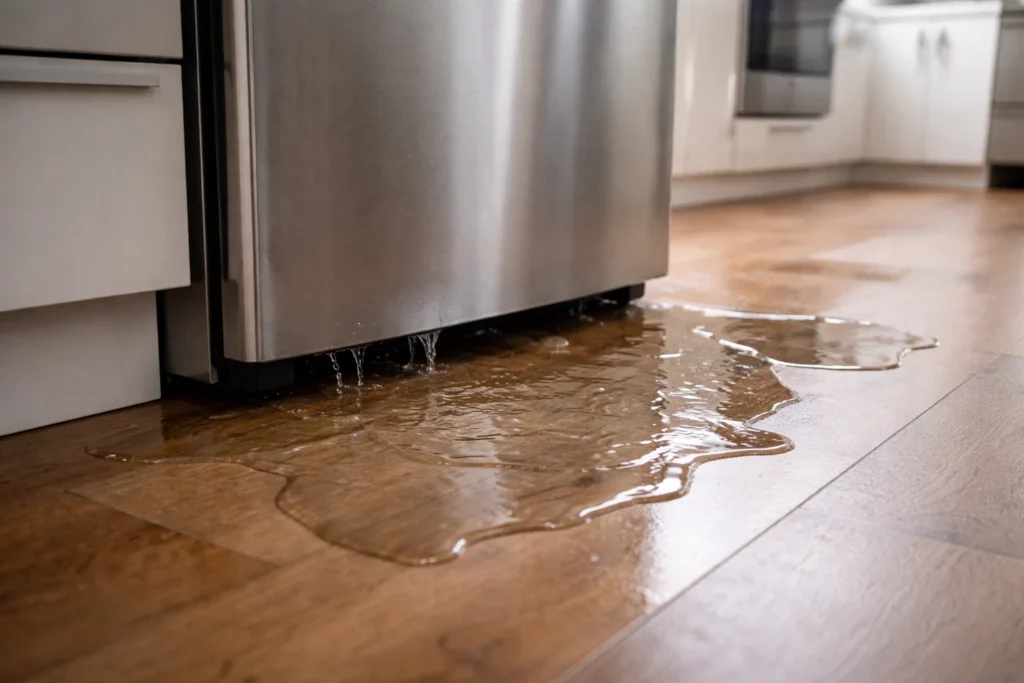
What to do
- Pull the fridge out gently.
- Inspect the tubing for kinks, cracks, or wet spots.
- Tighten compression fittings by hand (don’t overtighten).
- If tubing is brittle or damaged, replace it (common sizes: 1/4″ plastic or braided line).
3) Replace or Reseat the Water Filter
A poorly seated filter can leak and drip down, leading to water leakage under the fridge.
What to do
- Remove the filter, wipe the housing, and reinstall firmly.
- Check for the correct filter model.
- If the O-rings look damaged, replace the filter.
4) Inspect the Door Gasket (Seal) and Door Alignment
Warm air enters, moisture condenses, and that water can drip and pool—sometimes mistaken for plumbing issues.
Quick checks
- Close the door on a sheet of paper; if it slides out easily, the seal may be weak.
- Clean the gasket with mild soap and warm water.
- Ensure the fridge is level and doors close fully.
A bad seal can indirectly create water leakage under the fridge through excess condensation and frost.
5) Look at the Drain Pan Underneath
Most fridges have a pan that catches defrost water and evaporates it using compressor heat. If the pan is cracked or out of position, you’ll see water leakage under the fridge (often toward the back).
What to do
- Unplug the fridge.
- Remove the lower rear panel if needed.
- Check the pan for cracks or misalignment.
- Re-seat it properly; replace if damaged.
6) Confirm the Fridge Is Level
If the fridge tilts forward, water may not flow correctly into the drain and can escape.
Simple fix
- Use a bubble level (or a phone level app).
- Adjust the front leveling legs so the fridge is slightly higher in front (many models are designed this way so doors self-close).
A Short Troubleshooting Checklist
Use this list when you’re not sure where to start:
- Wipe the floor dry and note exactly where water reappears.
- Check inside bottom shelves/crispers for hidden water.
- Inspect the door gasket and confirm doors close tightly.
- If you have an ice maker: inspect the supply line and filter area.
- Look for ice buildup around the freezer’s drain hole.
- Check the drain pan position underneath.
This process usually pinpoints water leakage under the fridge without guesswork.
When You Should Call a Technician
DIY is great—until it isn’t. Consider professional help if:
- You see water near electrical parts consistently.
- The leak continues after clearing the drain and checking the supply line.
- You suspect a cracked internal drain channel or a failing inlet valve.
- The fridge isn’t cooling properly alongside the leak.
Stop Water Leakage Under the Fridge From Returning
- Clean the defrost drain area every few months (especially if you have pets or a dusty kitchen).
- Replace water filters on schedule.
- Keep the fridge level and don’t overload the door shelves (it can warp alignment).
- Avoid leaving doors open for long—frost buildup often triggers later leaks.
If you want, tell me whether your fridge has an ice maker/water dispenser and where the puddle appears (front/back/left/right). I’ll narrow it down to the top 1–2 causes and the exact fix path for your situation—without extra steps.