

Content:
- Quick Answer
- Why Ice Makers Stop Making Ice
- Common Warning Signs
- Quick Causes & Fixes Table
- How to Tell If It’s a Reset Issue
- DIY Ice Maker Troubleshooting Steps
- Frozen Fill Tube Problems
- Water Filter & Water Pressure Issues
- Freezer Temperature Problems
- When to Call a Professional
- Frequently Asked Questions
- Final Thoughts
Quick Answer
An ice maker that stops making ice is usually caused by freezer temperature problems, frozen fill tubes, clogged water filters, weak water pressure, reset issues, faulty inlet valves, or blocked sensors. In many cases, resetting the ice maker and restoring proper airflow solves the problem without replacing parts.
If your refrigerator dispenses water normally but no ice is produced, the issue is often isolated to the ice maker system itself rather than the refrigerator’s main cooling system.
This article was reviewed by experienced appliance repair technicians servicing Whirlpool, Samsung, LG, GE, Frigidaire, KitchenAid, Bosch, Sub-Zero, and Maytag refrigerators throughout New York City.
Why Ice Makers Stop Making Ice
Ice makers work in freezing conditions while constantly cycling water, sensors, motors, heaters, and valves. Because several systems work together, even a small issue can stop ice production completely.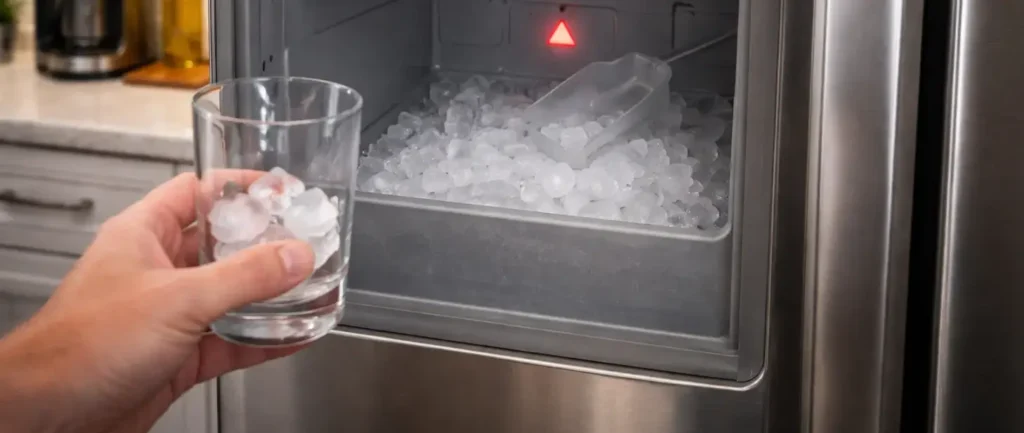
The most common causes include:
- Freezer temperature above 0–5°F
- Frozen or blocked water fill tube
- Clogged refrigerator water filter
- Faulty water inlet valve
- Ice maker stuck mid-cycle
- Control board or sensor problems
- Ice maker accidentally turned off
| Problem | What Happens |
|---|---|
| Weak water flow | Ice tray never fills properly |
| Freezer too warm | Ice harvest cycle stops |
| Frozen fill tube | Water cannot reach ice mold |
| Faulty inlet valve | No water enters ice maker |
| Bad sensor or module | Ice maker stops cycling |
Common Warning Signs
- Ice bin stays empty for long periods
- Ice cubes become unusually small
- Ice maker makes clicking noises but no ice
- Water dispenser works but ice maker doesn’t
- Status lights blink or show “Ice Off”
- Ice clumps together inside the bin
- Freezer temperature fluctuates
Quick Causes & Fixes Table
| Cause | Typical Symptoms | Possible Fix |
|---|---|---|
| Ice maker switched off | No cycling or sounds | Enable ice maker |
| Frozen fill tube | No water entering mold | Defrost tube carefully |
| Dirty water filter | Small cubes or slow fill | Replace filter |
| Warm freezer | Slow or no ice production | Lower freezer temperature |
| Bad inlet valve | No fill after harvest cycle | Valve replacement |
How to Tell If It’s a Reset Issue
Sometimes the ice maker itself isn’t broken — the control module simply gets stuck after a power outage or interrupted cycle.
Signs of a Reset Problem
- Freezer temperature is normal
- Water dispenser still works
- Display shows flashing lights
- “Ice Off” mode is active accidentally
- Ice maker stopped after a power outage
Technician Tip: Holding the reset button for 5–10 seconds often forces a full harvest cycle and restores normal operation.
DIY Ice Maker Troubleshooting Steps
- Verify the ice maker is turned on.
- Check the shutoff arm or sensor.
- Reset the refrigerator or ice maker.
- Inspect the water filter.
- Confirm freezer temperature stays near 0°F.
- Check for frozen fill tubes.
- Inspect the water supply line behind the refrigerator.
- Wait several hours after resetting.
Frozen Fill Tube Problems
The fill tube directs water from the inlet valve into the ice mold. If the tube freezes:
- Water cannot reach the tray
- The ice maker cycles without filling
- Ice production stops completely
Water Filter & Water Pressure Issues
A clogged refrigerator water filter restricts water flow to the ice maker.
- Small or hollow ice cubes
- Weak dispenser flow
- Slow ice production
- Incomplete tray filling
Freezer Temperature Problems
Ice makers depend heavily on freezer temperature.
| Freezer Temperature | Ice Maker Performance |
|---|---|
| 0°F (-18°C) | Optimal ice production |
| 5°F (-15°C) | Slow production possible |
| 10°F (-12°C) or warmer | Ice production may stop |
When to Call a Professional
- The ice maker still won’t fill after resetting
- The freezer is cold but no harvest occurs
- You hear buzzing from the inlet valve
- Error codes continue returning
- The fill tube freezes repeatedly
- The refrigerator leaks water
- Control board or sensor issues appear
Schedule professional ice maker repair in New York
Frequently Asked Questions
Why is my ice maker not making ice but water works?
This usually indicates a problem isolated to the ice maker system itself, such as a frozen fill tube, faulty module, or bad inlet valve.
How do I reset my refrigerator ice maker?
Most ice makers include a reset or test button. Hold it for approximately 5–10 seconds until the cycle begins.
Can a clogged filter stop ice production?
Yes. Restricted water flow from an old filter can prevent proper filling of the ice mold.
How cold should my freezer be for the ice maker?
Most ice makers operate best around 0°F (-18°C).
Why does my fill tube keep freezing?
A leaking inlet valve may slowly drip water between cycles, eventually freezing inside the tube.
Final Thoughts
Ice maker problems are often caused by simple issues like clogged filters, frozen fill tubes, reset failures, or incorrect freezer temperatures.
Fortunately, many ice maker issues can be solved without replacing expensive refrigerator components.
If resetting the system and checking water flow doesn’t restore ice production, professional refrigerator repair can quickly identify faulty valves, sensors, modules, or control boards before larger cooling problems develop.
Replacing refrigerator water filters every 6 months and keeping freezer temperatures near 0°F helps prevent most common ice maker problems.