

Your Whirlpool fridge is usually quiet and predictable—until it flashes a code you’ve never seen before. Those messages aren’t random: they’re the appliance’s way of pointing to a specific system (temperature sensing, defrost, airflow, door switches, communication, and more). This guide breaks down whirlpool refrigerator error codes in plain English, so you can take the right first steps without guesswork.
Why Whirlpool Refrigerators Show Error Codes
Most modern Whirlpool models use sensors and control boards to monitor:
- freezer/fridge temperatures
- evaporator & condenser fan operation
- defrost cycle performance
- door status and dispenser functions
- communication between boards (main control, user interface, etc.)
When something looks abnormal for long enough, the control system logs it and displays a code. Learning the logic behind Whirlpool refrigerator error codes helps you decide whether it’s a quick reset, a simple maintenance job, or a service-level repair.
Before You Do Anything: 3 Smart First Checks
1) Snapshot the situation
Write down the code exactly as shown (letters, numbers, dashes). Some codes appear briefly and then disappear.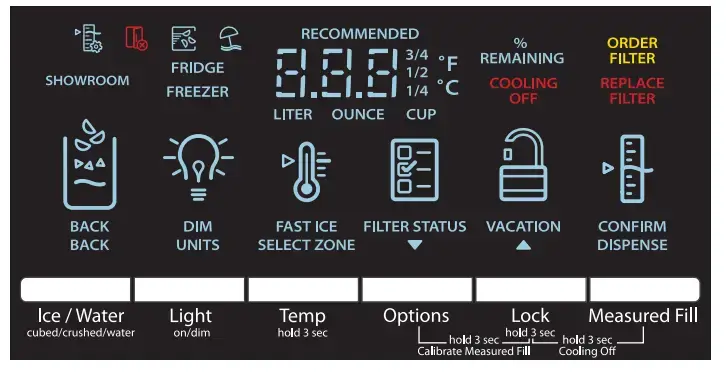
2) Check the basics
- Is the door fully closing?
- Is airflow blocked by overpacked shelves?
- Are vents covered by frost or food packaging?
- Did you recently have a power outage or voltage dip?
3) Try a safe reset
If food safety isn’t at risk and the fridge is still cooling:
- Unplug for 5 minutes
- Plug back in and wait 10–15 minutes to see if the code returns
If the code comes back quickly, it’s usually a real fault—not a “glitch.”
Common Whirlpool Refrigerator Error Codes
Notes: Error formats vary by series (WRS, WRX, WRF, French door, side-by-side). Your exact list may differ, but the categories below cover the faults most commonly seen across Whirlpool electronic models.
| Error Code (examples) | What It Usually Means | What You Can Do First (Safe Steps) | When It’s Likely a Pro Job |
|---|---|---|---|
| PO | Power outage detected | Confirm temps, allow 24 hrs to stabilize, clear alert | If cooling doesn’t recover or codes stack |
| CF | Communication fault between boards (main/UI) | Power reset; check if display responds normally | If it returns: wiring harness/UI board/main board diagnosis |
| dH | Defrost heater issue / defrost system not heating | Check for heavy frost on freezer back panel; don’t chip ice | Heater, bimetal/thermistor, control board testing |
| dF | Defrost fault (cycle not completing properly) | Verify door seals, reduce door openings, reset | Persistent frost: sealed panel removal & electrical tests |
| E1 / E2 | Temperature sensor (thermistor) out of range | Ensure vents aren’t blocked; reset | Sensor replacement or wiring/board issue |
| F1 | Freezer thermistor fault | Check for unusual frosting; reset | Sensor/harness testing; replacement |
| F2 | Refrigerator thermistor fault | Check airflow and damper area; reset | Sensor/harness testing; replacement |
| F3 | Evaporator thermistor fault | Look for uneven cooling, frost patterns | Sensor replacement; defrost system check |
| F5 | Evaporator fan problem | Listen for fan; ensure nothing hits fan blade | Fan motor, harness, control board |
| F6 | Compressor/drive issue (varies by model) | Ensure condenser coils are clean; reset | Compressor start device/inverter/board diagnosis |
| DR / dO | Door open (or switch issue) | Close door firmly; check gasket; clear obstructions | If door is closed but alert stays: door switch/harness |
| SF | Showroom mode enabled (not cooling properly) | Disable showroom mode per manual steps (often key combo) | If UI is unresponsive or steps fail |
| ICE / iC | Ice maker fault (varies) | Check water supply valve open; inspect for frozen fill tube | Ice maker module/valve testing |
| H / HI | High temperature alarm | Verify seals, avoid frequent openings, check coil cleanliness | If temps won’t drop: airflow/defrost/compressor diagnosis |
If your model shows a slightly different code format, it often maps to the same subsystem. That’s why understanding the meaning matters more than memorizing every variant.
What Each Category of Code Usually Points To
Defrost-related codes (dH, dF, or similar)
If you’re seeing defrost-type whirlpool refrigerator error codes, the most common clue is frost buildup behind the freezer’s rear panel.
Typical signs:
- freezer temperature rises slowly
- fridge side warms while freezer still “kind of works”
- fan noise changes (fan hitting ice)
- airflow to the refrigerator compartment feels weak
Safe things you can try:
- Keep doors closed as much as possible
- Check that food packages aren’t blocking freezer vents
- Do a power reset
- If cooling is failing fast, move perishables to a cooler
Avoid using sharp tools to remove ice—puncturing a coil is an expensive mistake.
Sensor/thermistor codes (E1/E2, F1–F3, etc.)
Thermistors are small temperature sensors. A code often means the reading is “out of expected range,” which can be caused by:
- a failed sensor
- a loose connector
- damaged wiring
- rarely: a control board issue
What you can do:
- confirm airflow isn’t blocked
- make sure the fridge isn’t packed tight against vents
- reset and monitor temps for a few hours
If the error returns consistently, it’s usually part replacement + testing.
Fan/airflow codes (F5, fan-related alerts)
Fans keep air moving across coils and into compartments.
Quick checks:
- Listen: do you hear an evaporator fan in the freezer after the door is closed?
- Make sure nothing is physically obstructing fan airflow
- Clean condenser coils (this helps the whole system run cooler)
Fan codes that persist typically require access to internal panels and electrical testing.
Communication/power codes (CF, PO)
These are the “did something interrupt normal operation?” family.
- PO is usually informational: a power event happened.
- CF suggests control boards aren’t talking correctly.
If whirlpool refrigerator error codes appear after storms or outages, you may see them in clusters. If resets don’t stabilize the system, it’s time for diagnostics.
When You Should Stop Troubleshooting and Call Service
Call for service (or warranty support) if any of these are true:
- The fridge is not holding safe temperatures (food risk)
- The code returns immediately after reset
- You see heavy frost repeatedly after a manual defrost period
- The compressor is clicking repeatedly or the unit is unusually hot
- You smell burning, see scorch marks, or hear electrical buzzing
Many Whirlpool units also store error history, and a technician can read that to pinpoint the failure faster than trial-and-error.
How to Keep Error Codes from Coming Back
A lot of recurring issues are airflow and heat-exchange related. Simple habits help:
- Vacuum condenser coils every 3–6 months
- Leave clearance behind the fridge for ventilation
- Don’t block interior vents with large containers
- Replace torn or deformed door gaskets
- Keep freezer drawers and bins seated properly
Reducing strain on the cooling system reduces the chance of future whirlpool refrigerator error codes popping up.