
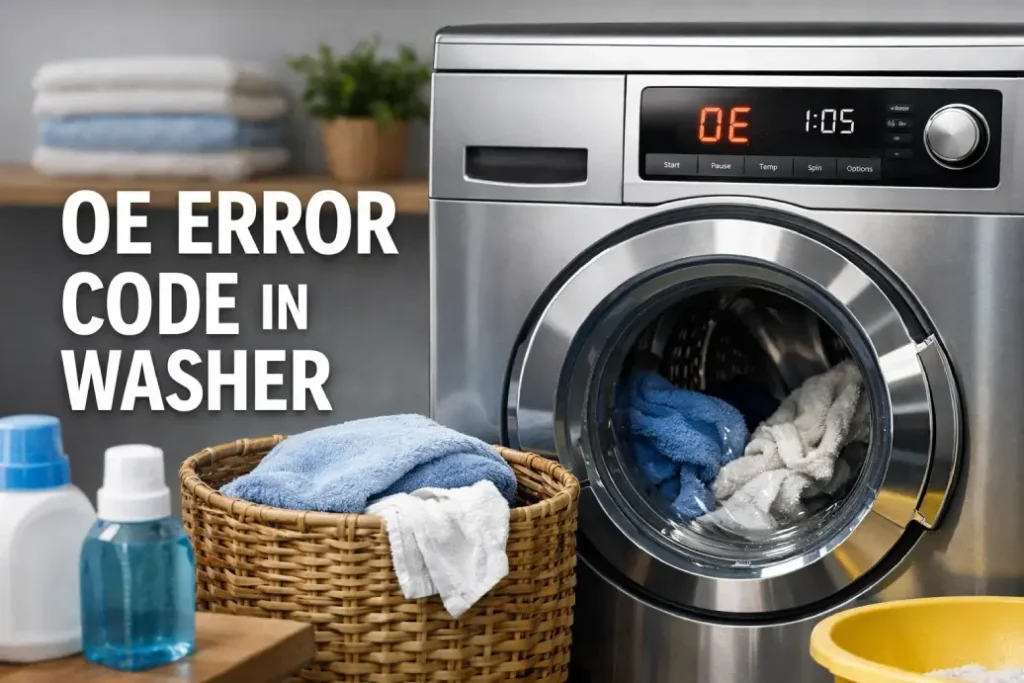
Seeing an OE error code washer message can feel like your laundry routine just hit a wall. The good news: in most cases, this code is tied to drainage—and many fixes are quick, safe, and don’t require tools beyond a towel and a small brush.
Below is a practical guide that explains what the code usually means, why it happens, and what you can check step-by-step before calling a technician.
What the OE Error Code Usually Means
On many washers (especially LG), an OE error code washer typically indicates the machine can’t drain water properly within a set time. When the washer detects water is still in the tub after it tried to pump it out, it triggers the error to prevent flooding or damage.
That said, “OE” isn’t perfectly universal. Some brands interpret similar drain/overflow codes differently. The safest approach is to treat it as a water movement problem first: draining, hose routing, filters, or pump.
The Most Common Causes
An OE error code washer is usually triggered by one of these:
- Clogged drain filter (coins, lint, hairpins, fabric threads)
- Kinked or crushed drain hose
- Blocked standpipe / household drain (your plumbing, not the washer)
- Pump obstruction (small items slipping past the filter)
- Faulty drain pump (wear, overheating, electrical failure)
- Drain hose installed too high / too deep causing siphon or slow drain
Quick Safety Checks Before You Start
Before touching anything:
- Power off the washer (unplug if possible).
- Put down towels—water may spill.
- If the tub is full, avoid opening the door forcefully (some models lock for safety).
Step-by-Step Fixes You Can Try at Home
1) Drain and clean the pump filter (most effective fix)
Many front-load washers have a small access door at the bottom front.
- Open the panel
- Place a shallow tray and towels
- Slowly unscrew the filter cap to let water drain
- Remove debris, rinse the filter, and reinstall tightly
If you only do one thing, do this first. A dirty filter is the #1 reason an OE error code washer pops up.
2) Inspect the drain hose (fast visual win)
Follow the hose from the washer to the wall/drain.
Check for:
- Sharp bends
- Crushing behind the machine
- Hose end shoved too far into the drain pipe (can cause poor airflow)
Tip: The hose should form a smooth curve, not a tight “U” kink.
3) Check the household drain (the sneaky culprit)
Sometimes the washer is fine—the plumbing isn’t.
Try:
- Draining a bucket of water into the same standpipe/sink drain
- Watching for slow flow or backup
If it gurgles, rises, or backs up, your washer may be throwing an OE error code washer because the house drain can’t accept water fast enough.
4) Run a spin/drain-only cycle (after cleaning)
After filter + hose checks, run a Drain/Spin cycle:
- If it drains normally: you likely fixed it.
- If it tries to drain but fails again: move to pump checks.
5) Listen for the pump
During draining you should hear a steady pump sound.
- Humming but no draining often means the pump is blocked or failing.
- No sound at all could point to a pump power issue, wiring, or control board (less common).
At this stage, you’re closer to repair territory—but you’ve already ruled out the easy stuff.
Common Washer Error Codes Related to Water Issues
Use this table as a quick translation guide. Exact meanings can vary by model/region, but these are the most common interpretations.
| Error code | Typical meaning | What to check first | Common on |
|---|---|---|---|
| OE | Drain error (water not draining) | Clean pump filter, inspect drain hose | LG (very common) |
| 0E / OE (variant) | Drain or overflow-related (varies by brand) | Filter, hose height, household drain | Mixed/varies |
| IE | Water not filling properly | Inlet valves, water supply, hose screens | LG (common) |
| FE | Overflow / overfill detected | Turn off water, check inlet valve | LG (common) |
| UE | Unbalanced load (won’t spin) | Redistribute load, check leveling | Many brands |
| LE | Motor/locking issue (varies) | Reset power, reduce load | Often LG |
If you’re specifically seeing OE error code washer, treat it as a draining workflow problem until proven otherwise.
Why the Error Comes Back Even After “Fixing” It
If the OE error code washer returns repeatedly, it usually means one of these is still happening:
- The filter was cleaned, but debris is lodged deeper in the pump
- The drain hose looks fine, but the standpipe is partially blocked
- The pump is intermittently failing (works sometimes, stalls other times)
- The hose placement causes slow siphoning or poor flow
A useful test: run 2–3 drain cycles in a row with an empty drum. If cycle 1 passes and cycle 2 fails, that pattern often points to a pump that overheats or sticks.
When It’s Time to Call a Technician
Consider professional help if:
- The washer won’t drain at all after filter + hose + drain check
- You hear repeated pump humming but no water movement
- There’s burning smell, loud grinding, or electrical tripping
- Water leaks from underneath during drain attempts
You’ll be able to describe what you already tried, which usually speeds up diagnosis (and avoids unnecessary parts swaps).
Simple Prevention (so it doesn’t happen again)
To reduce the chance of another OE error code washer alert:
- Empty pockets (coins are pump-killers)
- Use a mesh bag for small items (baby socks, bra pads)
- Clean the filter every 1–2 months if you wash often
- Avoid overusing detergent (excess suds can slow draining)
- Keep the drain hose neatly routed with no crushing