
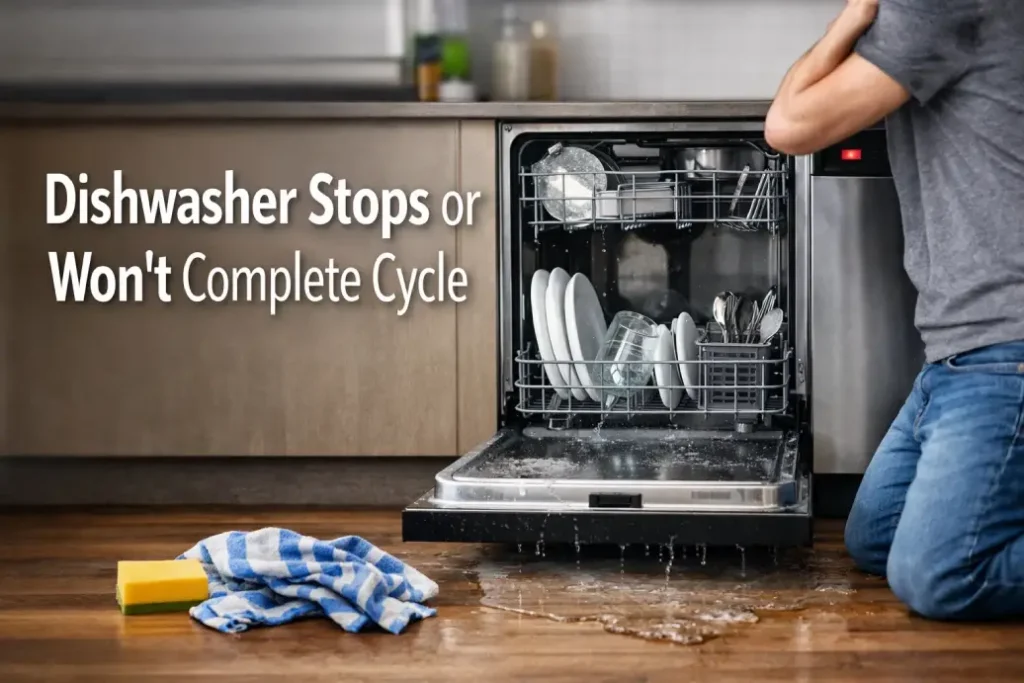
A dishwasher that stops mid-cycle can turn a simple routine into a sink full of stress. If your dishwasher stops or won’t complete cycle, the good news is that the cause is usually something practical—power, water, drainage, a sensor, or a safety switch—and many fixes are quick.
Below is a step-by-step, reader-friendly guide to diagnose the problem safely, restore normal operation, and reduce the chances it happens again.
Why a Dishwasher Stops Mid-Cycle
When a dishwasher stops or won’t complete cycle, it’s typically because the machine detects a condition that could cause damage (overheating, leaking, no water, blocked drain) or it’s not receiving consistent power or water.
Common categories:
- Power interruptions or control issues
- Water supply problems
- Drainage clogs or pump issues
- Door latch and safety interlocks
- Heating and temperature faults
- Sensors and float switch triggers
Quick Safety Check Before Troubleshooting
If your dishwasher stops or won’t complete cycle, start with safe basics:
- Turn off the dishwasher and wait 5 minutes.
- If water is pooled, don’t run another cycle yet.
- If you smell burning or see smoke: switch off power at the breaker and stop.
Step-by-Step Troubleshooting
1) Power and Reset Issues
If the dishwasher stops or won’t complete cycle, power is the first thing to rule out.
What to do
- Check if the outlet works (plug in a lamp).
- Check your breaker/GFCI and reset it if it tripped.
- Try a simple reset: turn the dishwasher off, wait 1–2 minutes, then restart.
Why it matters
A brief voltage drop can pause a cycle and leave the machine “confused,” especially on newer electronic models.
2) Door Latch Not Fully Engaged
A loose latch is one of the most common reasons a dishwasher stops or won’t complete cycle—the unit thinks the door is open and shuts down for safety.
What to do
- Close the door firmly until it clicks.
- Inspect the latch area for debris, bent metal, or misalignment.
- Avoid leaning on the door during a cycle.
Tip
If it stops when you bump the door, the latch or switch may be worn.
3) Water Supply Problems (Not Filling or Filling Slowly)
When a dishwasher stops or won’t complete cycle, it might not be getting enough water.
What to check
- Make sure the shutoff valve under the sink is fully open.
- Confirm the inlet hose isn’t kinked.
- If your home had water work recently, air or sediment can affect fill.
A practical sign
You start a cycle, hear a short hum, then it goes silent or drains immediately.
4) Drainage and Filter Blockages
A clogged filter or drain path can cause the cycle to pause or end early—so your dishwasher stops or won’t complete cycle because it can’t move water out.
What to do
- Remove and rinse the filter (usually at the bottom).
- Clear food particles and grease.
- Check the drain hose connection to the sink/disposal for buildup.
Bonus check
If your sink drains slowly too, the issue may be the shared plumbing, not the dishwasher.
5) Float Switch Triggered (Overfill Protection)
Many machines stop instantly if the float switch senses “too much water.” That can make it seem like the dishwasher stops or won’t complete cycle randomly.
What to do
- Locate the float (small dome/column at the tub bottom).
- Lift it gently—listen for a click.
- Clean around it so it moves freely.
When it triggers incorrectly
Soap buildup or debris can hold the float in the “up” position.
6) Heating Element or Temperature Faults
If water doesn’t heat correctly, the machine may pause, drain, or stall—another reason a dishwasher stops or won’t complete cycle.
Common symptoms
- Cycles take much longer than usual
- Dishes are cold and wet at the end
- The unit stalls during wash or dry phases
What you can do without tools
- Run hot water at the sink for 30–60 seconds before starting the dishwasher.
- Use a normal cycle (not eco) as a test—eco cycles can appear “stalled” because they run longer by design.
7) Control Board, Timer, or Sensor Issues
If everything above checks out and the dishwasher stops or won’t complete cycle repeatedly in the same phase, the control system may be failing.
Patterns that hint at electronics
- Stops at the same minute mark each time
- Buttons become unresponsive
- Random beeping or flashing codes
At this point, checking the user manual for error codes is the fastest path. If codes persist after a reset, professional service is often the most cost-effective choice.
A Simple Diagnostic Flow You Can Follow
If your dishwasher stops or won’t complete cycle, run this quick order:
- Power / breaker / reset
- Door latch click + alignment
- Water valve open + hose not kinked
- Filter cleaned + drain path clear
- Float moves freely
- Preheat tap water + test normal cycle
- Check error codes / consider service
Prevention
To reduce the chances your dishwasher stops or won’t complete cycle again:
- Rinse large food scraps (no need to pre-wash fully).
- Clean the filter every 1–2 weeks if you run it often.
- Run hot water at the sink before starting.
- Use the correct detergent amount (too much can cause foaming and sensor issues).
- Avoid overloading—spray arms need space to spin.